Background
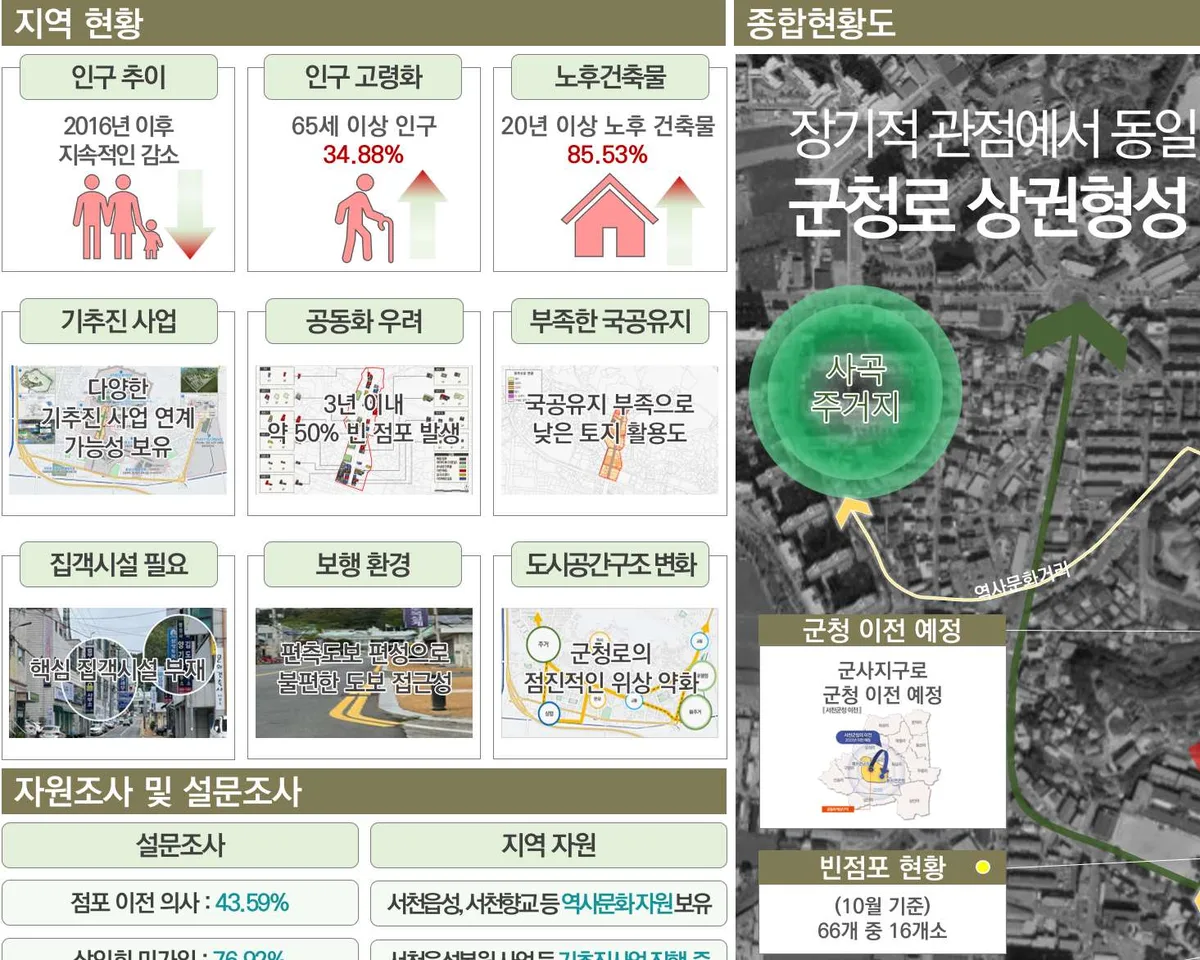
Seocheon County possesses abundant natural assets and cultural heritage resources, yet the historic city center has lost its pivotal role in urban functions due to rapid urbanization and restructuring. Gungjung-ro, once the central axis of Seocheon with concentrated administrative, commercial, and cultural functions, now faces challenges of urban decline, aging infrastructure, and dispersed commercial activity. To address these urban challenges and revitalize the local economy, a comprehensive strategy that builds new competitive advantages for Gungjung-ro based on the region's assets was essential.
Approach
This project focused on developing an integrated commercial revitalization strategy encompassing both physical improvements and institutional reforms. Through extensive field surveys, stakeholder engagement, and expert consultations, practical solutions were derived. By analyzing domestic and international best practices, a distinctive revitalization direction tailored to Seocheon's unique characteristics was established. The strategy emphasizes organic connections among cultural resources, tourism infrastructure, and commercial facilities to build a sustainable commercial ecosystem.
🎯
Differentiation
Establish unique value
based on regional assets
🌟
Attraction
Strengthen visiting
motivations & foot traffic
🔗
Connectivity
Network resources
for synergies
📈
Sustainability
Self-driven growth
ecosystem development
These four core strategies are grounded in a collaborative framework involving community participation, small business activation, and administrative support. When private-sector initiatives and public infrastructure development combine effectively, the vision of "A Vibrant Urban Center with Appealing Gungjung-ro" becomes achievable.
Key Proposals
The basic plan includes concrete, implementable projects. These encompass improving pedestrian environments through public space activation, expanding cultural facilities for iconic district identity, operating small business support programs, strengthening connections between regional tourism resources and commercial facilities, and enhancing urban appeal through nighttime landscape design. Additionally, the plan promotes diverse commercial uses including real estate agencies, restaurants, and retail shops, with tourism-oriented commercial district development linked to Seocheon's tourism infrastructure. The plan also establishes support systems for self-sustaining commercial vitality through small business financing, joint marketing, and merchant association activation.
Expected Impact
30%
Commercial Sales Increase
Through phased implementation of this basic plan, quantitative outcomes including 25% increase in Gungjung-ro foot traffic, 30% increase in commercial sales, 15 new business startups, and 45% increase in dwell time are expected. Qualitatively, the plan aims to establish regional urban identity, strengthen local economic self-reliance, and improve urban living environments. These achievements will position Gungjung-ro as a signature commercial district and key hub for local economic revitalization.
Project Significance
This project distinguishes itself by reconceptualizing commercial revitalization not as mere physical improvement, but as an integrated urban regeneration strategy grounded in regional assets and potential. By weaving together historical and cultural resources, tourism infrastructure, and small business capabilities, a unique competitive foundation for Gungjung-ro has been designed. An implementation framework engaging residents, merchants, and administration collectively creates the foundation for sustainable commercial revitalization.
#CommercialRevitalization
#BasicPlan
#SeocheonCounty
#UrbanRegeneration
#SmallBusiness
#TourismLinked
#UrbanCenter
#LocalEconomy
#VibrantCity